My name is Sam Northern, and I am a 2016 Lindblad Expeditions and National Geographic Grosvenor Teacher Fellow. In December of 2016, I had the opportunity to embark on a Lindblad voyage aboard National Geographic Explorer to Antarctica for a one-of-a-kind field experience. The Grosvenor Teacher Fellowship has supported my efforts in developing a library media curriculum that gives students the opportunity to research places and cultures around the world. I invite you to join my adventure. Click the title at the end of each page to follow my journey to Antarctica: The White Continent.
Click HERE to access my photos from the expedition.
It was a Wednesday evening; I had
just arrived home from school. After sitting down on the couch and grabbing
the remote, my phone began to ring. The number, not stored in my contacts, was “Unknown”. Immediately my heart began to race. The
cocoons in my stomach hatched, leaving a swarm of butterflies fluttering
inside. I knew that recipients of the National Geographic Grosvenor Teacher
Fellow Program would be notified by phone in mid-February. Questions raced
through my mind: “Who could this be?” “Could it?” “Does Nat Geo call to notify
those not selected, too?” When the voice from the other line uttered “National
Geographic”, I inched towards the very edge of the couch. What came next? It is difficult to recall. I remember being congratulated
as a 2016 Grosvenor Teacher Fellow. Me, a Fellow? Miraculously I was standing in
the other room—how I got there, I am not quite sure. After a few celebratory
hoots and air pumps, I discovered that on December 17th I will be
embarking on an adventure of a lifetime—to Antarctica! For fourteen days I will
be traveling from Kentucky to Antarctica to home again. The phone called ended
as suddenly as it began. I was going to Antarctica, the end of the Earth. But for
me, the journey was only beginning.
All 35 selected 2016 Grosvenor
Teacher Fellows met together from April 14th to the 17th
for the first and very likely…the last time. We were invited to National Geographic
Society headquarters in Washington, D.C. for a Grosvenor Teacher Fellow
Workshop to meet with Lindblad expedition naturalists, previous educators who
have participated in the program, and attend a photography workshop.
Courtesy of Winn Brewer
There, we learned about the
program—its purpose, expectations, and even its origins. In fact, this year
marks the 10th year of the Grosvenor Teacher Fellow Program, established to
honor former National Geographic Society Chairman Gilbert M. Grosvenor’s
lifetime commitment to geographic education. The expeditions were donated in
perpetuity to the National Geographic Society by Sven-Olof Lindblad and
Lindblad Expeditions to mark Grosvenor’s 75th birthday in 2006 and to honor his
service in enhancing and improving geographic education across the United
States.
One question I had been frequently
asked by family, friends, and colleagues leading up to the D.C. workshop was, “So,
what exactly will you be doing in Antarctica?” Fortunately, the workshop
described life aboard our ship, the National Geographic Explorer. I learned how
Lindblad-National Geographic’s polar expedition team will enable me to:
oSee legendary landscapes and habitats.
oEncounter iconic penguins, leopard seals, and
marine mammals.
oKayak among icebergs, Zodiac cruise past resting
leopard seals, and hike on the continent with the best ice team on Earth.
oExperience the seldom-seen Antarctic undersea,
too––through the efforts of an undersea specialist.
I was even selected to participate
in an “Antarctic Fashion Show” which demonstrated the proper gear needed when
visiting the White Continent.
Courtesy of Dave Walker
Most importantly perhaps, I was
granted the opportunity to collaborate with other Fellows regarding my
Classroom Action Plan and Outreach Activities. These esteemed teachers and
librarians offered invaluable advice about my proposed Antarctica curriculum as
well as suggestions for other instructional plans related to geographic
literacy.
As teacher-librarian, I promote
inquiry-based learning by challenging students to “discover” information via
collaboration and research models. This experience will be invaluable to my
student’s mastery of information-seeking strategies and inquiry skills founded
in project-based learning. The knowledge I gain about geography and resources
suitable for my students will support my development of research projects that
embrace aspects of physical Earth and the people who settle it.
Like my students, I too will soon discover
more of the world once I embark on my voyage to Antarctica. The 2016 Grosvenor
Teacher Fellows have found ourselves in a remarkable position—to share our
discoveries with each other, our students, colleagues, and communities. In
doing so, we will make remote places from around the world seem just a
little closer to home for all to explore.
I designed and created a bulletin board for the school library to sustain students’ excitement about my upcoming excursion to Antarctica. Each week a handful of students come in the library to remind me of how many weeks are left before my adventure. Together, my students and I share an enthusiasm for traveling abroad to learn more about the fascinating world in which we live. We cannot wait for the day when the number of "weeks to go" changes from one to zero.
Three weeks prior to my departure for the "end of the earth", I received a pre-voyage package from Lindblad Expeditions. I was overjoyed when I first saw the Lindblad/National Geographic logo above the sender’s return address. I immediately opened the package and found a baseball cap, luggage tags, and a name badge.
The following documents were also included:
•Cruise Ticket
•Itinerary/Contact Information
•Staff Biographies
•Cabin Tags
•Airline Ticket
•Buenos Aires Taxi Guidelines
•Antarctica Primer
•Don’t Pack a Pest Leaflet
Admittedly, the package’s contents were overwhelming at first. However, I found the information to be very helpful. The documents eased my mind as I prepared for the journey. I learned that the ship offers internet access by purchasing a pre-paid debit access card on-board. I discovered many tidbits like making a photocopy of my airline tickets and the main page of my passport in case of an emergency. The best part was undoubtedly the “Final Itinerary”. My imagination ran wild with the sights, sounds, and tastes I would soon experience on my way to the bottom of the earth and back. CLICK HERE to check out the day-by-day itinerary for Journey to Antarctica: The White Continent.
Packing for a two-week excursion to Antarctica with stops in
Buenos Aires and Ushuaia, Argentina seems a daunting task…at first. Fortunately,
Lindblad Expedition’s website and customer service team provided clear
expectations for how to “gear up”. You can check out the full packing list here. My anxiety first subsided after doing some
research via the site’s FAQ’s. There, I learned that the on-board atmosphere is
casual and comfortable; no need for formal attire. The average air temperature
in Antarctica would be between 30 to 40 degrees Fahrenheit during our voyage. This is
similar to the weather I am accustomed to during the Kentucky winter months. Thus,
most of the gear suggested I already had. What’s more, the two articles of
clothing I was most concerned about, a parka and footwear, would be
provided! Lindblad Expeditions rented the Grosvenor Teacher Fellows a pair
of fully waterproof knee-high rubber boots to keep our feet dry when stepping
into shallow, icy water during wet Zodiac landings. Plus, every passenger
on-board the National Geographic Explorer was supplied a fully lined windproof,
water resistant parka which we got to keep!
Lindblad Expeditions has proven itself a first-class travel
company for 50 years, ever since Lars-Eric Lindblad took the first group of
"citizen" explorers to Antarctica in 1966. I experienced the
organization’s esteemed service before my journey even began. The provided
travel documents, conversations with customer support, and emails with my
on-board mentor made packing and my overall preparation for the adventure
extremely enjoyable. Soon I would be the one behind the lens of a camera like
the photographers before me who took the beautiful pictures on the Lindblad
Expedition website.
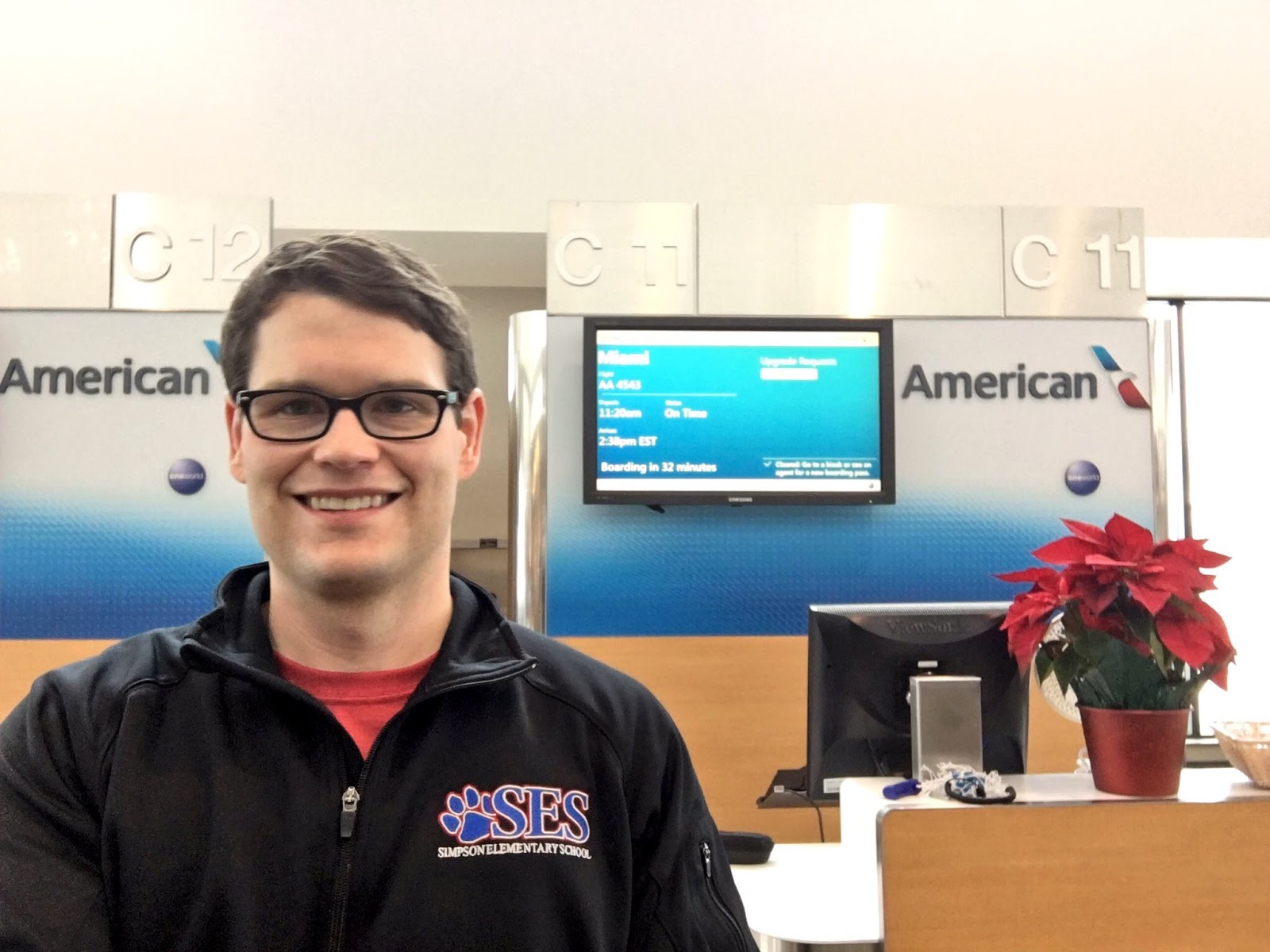
The first step of my journey to Antarctica was taking a flight from Nashville, Tennessee to Miami, Florida.
The short two-hour flight was only a tease for the second leg of my journey: a nine-hour layover at the Miami Airport. At 11 p.m. we finally boarded our plane for Buenos Aires, Argentina. On-board, I happily watched the newly released film, The BFG before being overtaken by exhaustion.
The 4520 mile flight from Miami to Buenos Aires took approximately eight hours. The 80 degree temperature was a pleasant contrast from the 20 degree weather I was experiencing back home in Kentucky. As we approached the Sofitel Hotel in downtown Buenos Aires, its ornate gate reminded me of the numerous opportunities ahead. I walked through without hesitation.
The other Grosvenor Teacher Fellows (Dave Walker and Randy French) and I share a love for adventure. Our first adventure began as a leisurely walk to a nearby market that almost ended in disaster. Shortly after leaving the hotel, we proceeded down a quiet street. Behind us a voice shouted, “Hello! Are you American?” I suppose it was the cameras hanging around our necks and the outstretched maps that gave us away. We soon discovered the person behind the voice, a lovely lady from North Carolina. She nicely informed us to avoid a certain street ahead and take a safer route to which she led us. Our “rescuer” had been living in Buenos Aires for several years and from her we learned a great deal about the city’s cuisine, shopping, and sites. Upon arrival to the market, I purchased a mate gourd for 200 pesos ($14 U.S. dollars).
Mate is a traditional South American caffeine-rich infused drink that many drink from a hand-crafted gourd. Mate is traditionally drunk in social settings, such as family gatherings or with friends. In fact, the same gourd and straw are used by everyone.
The afternoon city tour was a terrific overview of Buenos Aires. We witnessed tango dancers outside restaurants, soccer fans sporting their favorite team for the night’s big game, and market goers perusing sellers’ tents.
We strolled outside the Casa Rosada, the office of the President of Argentina before visiting the Buenos Aires Metropolitan Cathedral (Pope Francis’ mother church), and then La Recoleta Cemetery which contains the graves of notable people like Eva Perón
Casa Rosada
Just when I thought our day in Buenos Aires could not get any better; it did. The Fellows and I met up with Lindblad staff at El Mirasol de la Recova restaurant for a delicious rib-eye steak. It was the best cut I have ever tasted. Believe it or not, I would be thinking of this meal when I awoke the next day.
“In South America, one rarely knows what to expect one day from the next,” said the speaker on the bus as we traveled to the airport for a flight to Ushuaia, Argentina where we were to board our ship, National Geographic Explorer, for Antarctica. We understood what the speaker meant by her saying. Our departure time for the airport changed three times that morning due to a general strike by transportation workers. Instead of leaving at the original time of 7 a.m., we left at 11:30 a.m. With a beautiful view of Buenos Aires from 4000 feet on-board our airplane, we began our 1486-mile journey to Ushuaia, the southernmost city in the world.
Buenos Aires
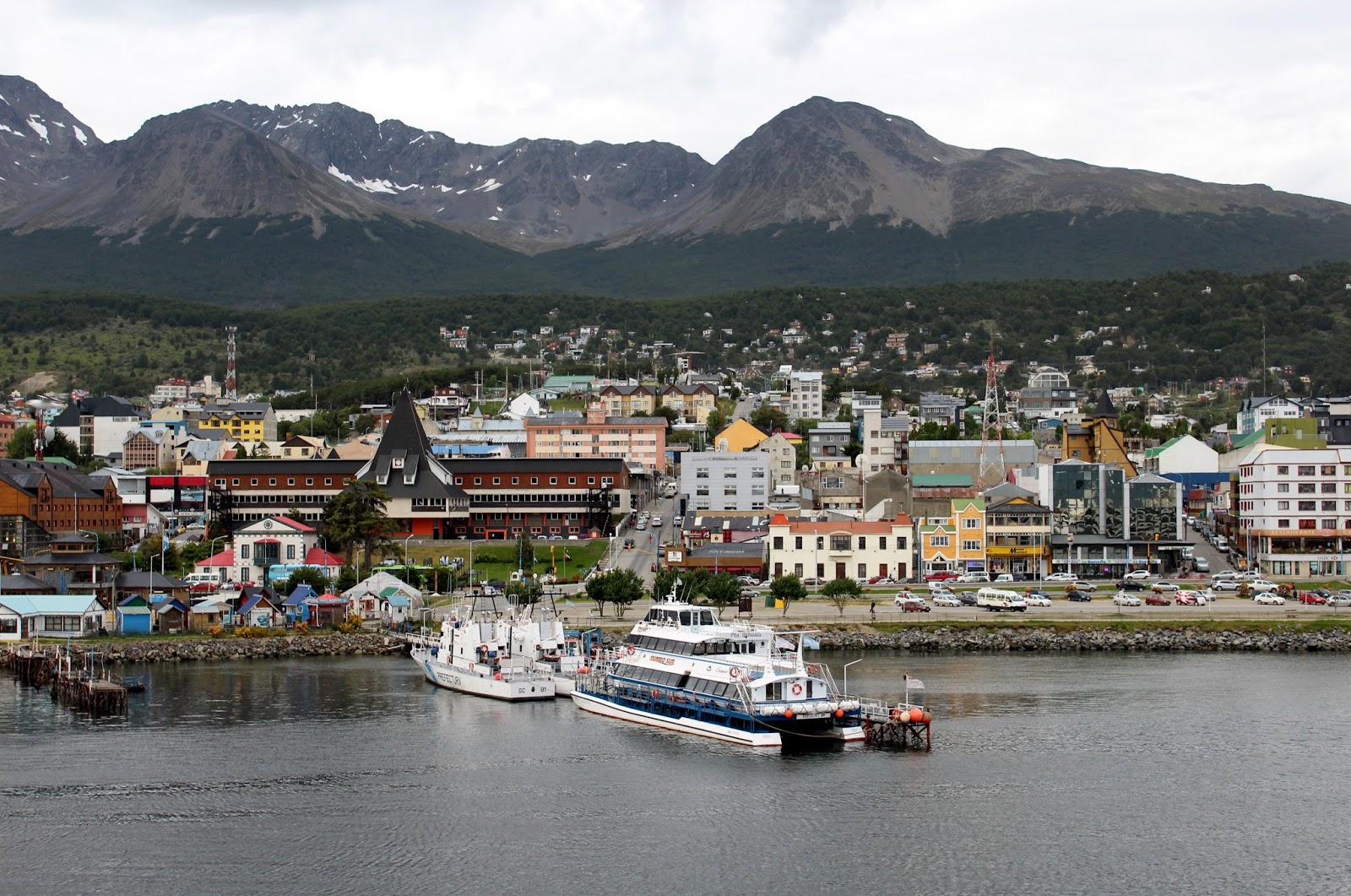
At 6 p.m. our plane made its descent past the picturesque Martial mountain range for a smooth landing in Ushuaia. The temperature in Ushuaia was 54 degrees Fahrenheit, a 26 degree drop from Buenos Aires. We could tell we were nearing Antarctica. Ushuaia is located in a wide bay on the southern coast of Isla Grande de Tierra del Fuego.
That night we reached our home for the next ten days, the National Geographic Explorer.
National Geographic Explorer
National Geographic Explorer is the most technologically advanced, fully stabilized, and accommodating expedition ship in the world. Explorer carries 148 guests in 81 cabins, 13 with balconies. She is equipped with a full set of exploration tools, including kayaks and Zodiac boats. With no time to waste, Explorer began its passage that night on the Beagle Channel, our gateway to the White Continent.
Despite having a peaceful slumber my first night on the ship, I awoke with a dose of the much dreaded sea sickness. I was quite unhappy about my current condition as well as embarrassed. Embarrassed because the Drake Passage, infamous for its rough sea conditions was as calm as can be expected. Yet, I was still ill! Nonetheless, I was able to have a fantastic day with the help of Dramamine, ginger, and plenty of water. It was an incredible sensation to sail through the Drake Passage which is known by seaman as the Drake Lake when winds and waves are mild. When conditions are rough as one expects of the Drake Passage, it is known as the Drake Shake. Drake Passage’s 500 mile wide passage is the shortest crossing from Antarctica to any other landmass. It is the spot where the Atlantic, Pacific, and Southern Seas converge, creating a roaring current mix. Yet, the National Geographic Explorer glided through the open water with ease.
After learning about the storm petrels, prions, and albatrosses from naturalist Doug Gaultieri, we headed out to the stern of the ship for a look. Even though the calm conditions make it difficult for many seabirds to fly, we spotted some of the largest seabirds including Giant Petrels and Wandering Albatrosses. Behind the ship was a beautiful Brown-Browed Albatross, hundreds of miles from land. Not once during my observation of this regal seabird did it flap its wings which span ten feet. The Albatross is designed to live on the water. This is their environment, not ours. My morning bout with motion sickness was proof that unlike the birds of the ocean, I am not destined for a life at sea. Still, the ship’s resources, observation decks, and staff planted in me a passion for all that exists above and below the surface of Earth’s oceans.
That evening, the temperature dropped from 9 degrees Celsius to 2 degrees while thick fog permeated the skies. Change was in the air. We continued south toward the Antarctic Convergence zone with an eager anticipation for what the morning would bring.
We crossed the Antarctic Convergence before the morning hours. I awoke knowing that I was officially in Antarctic waters. Our ship made its way to the South Shetland Islands. The first sight of land was a joyous occasion.
The other passenger and I were glued to the lobby’s glass in order to get a good view of the chain of mountains sprinkled with snow and ice. Amidst the ice cracks were hints of blue. The blue coloring appeared to glow, welcoming us much like a neon sign greets customers before entering.
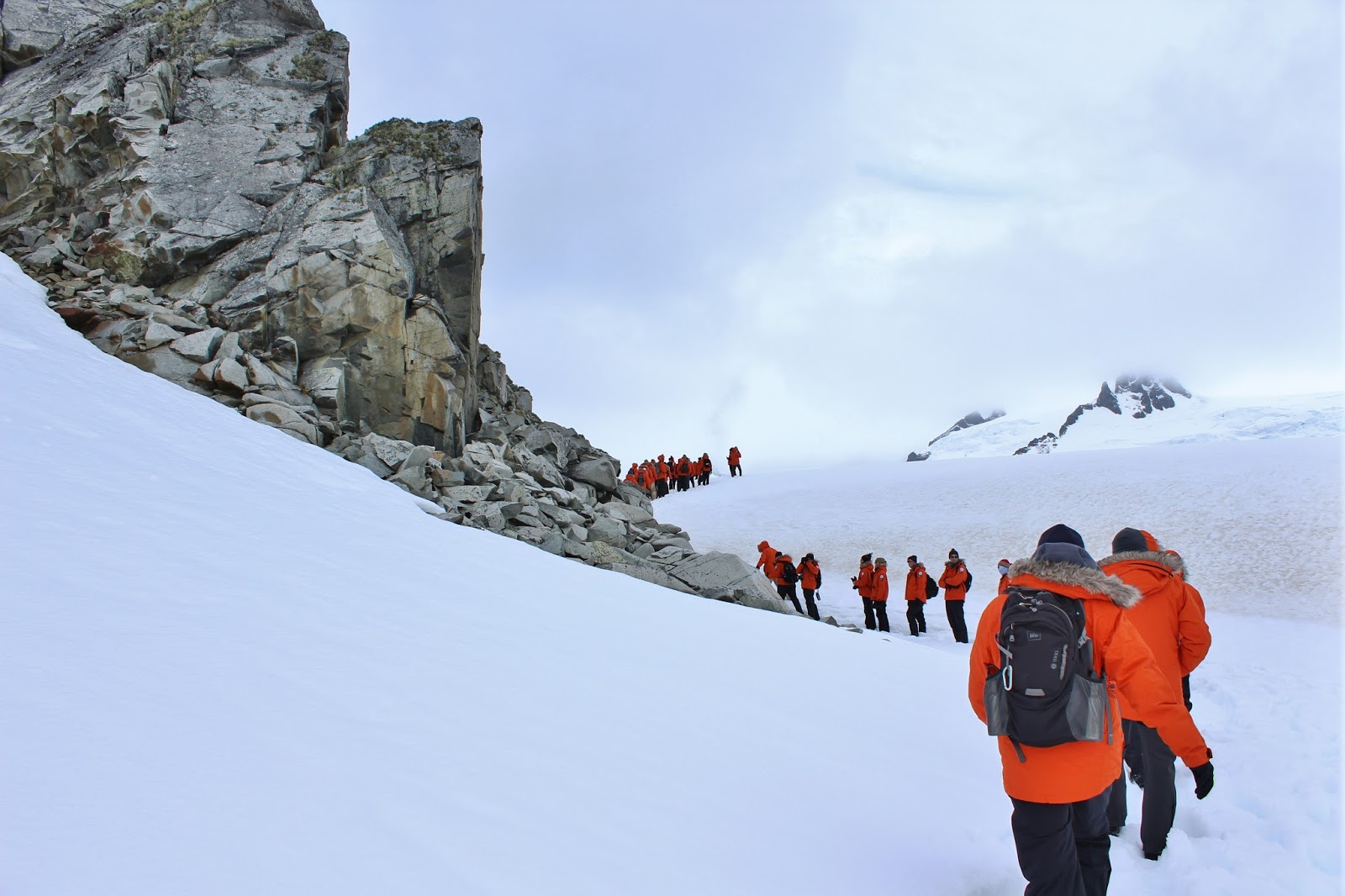
The ship made its way to the South Shetland Islands for our first landing. In our parkas, rain pants, waterproof boots, and life vests, we hopped into a Zodiac boat for a short cruise to Half Moon Island. You could feel the excitement among passengers as we drew closer to shore. Stepping off the boat and onto the rocks of the beach gave me a feeling of true exploration. I was exploring a place seldom seen by humankind. As we trekked toward the slope of a steep hill, I used my binoculars to see waves crashing into what I learned was an Elephant Seal. Seeming to be undisturbed by the waves and by us, we continued on our hike.
Elephant Seal
After much slipping and sliding, we made it the top of the hill.
From this vantage point, we could see Antarctica in all its icy glory. Following our descent, we made our way to the other side of the island where I had my first face-to-face meeting with a Chinstrap Penguin.
Chinstrap Penguins
Mesmerized by the way these flightless birds waddled and pecked at rocks, I was reminded of their habitat’s remoteness by how they were not in the least frightened by their human visitors. After all, these creatures have no reason to fear humans because there are usually never any around to harm them. Once the parcel of penguins I was observing gracefully swam away, no more than 50 yards ahead we spotted two Weddell Seals basking in the sun.
Weddell Seal
We couldn’t stay long because a Brown Skua began to fly overhead in preparation for a dive bomb if we did not quickly move away from her nest. We happily obliged.
Brown Skua
We neared our first penguin colony at the end of our hike. I could instantly tell that ahead were many penguins due to the rancid smell of their excrement. Despite the odor, the Chinstrap Penguins were incredible to watch. Many were perched on mounds of rocks to seal their eggs while other collected rocks or headed to and from the shore for a nice bath. Dirty penguins went down the hill; clean penguins came up. With paths for traveling, nests for comfort, and squawks for communicating, the colony resembled a working city. A civilization that has existed longer than many of the ones established by man. That alone is reason enough for humans to conserve Antarctica’s wildlife.
Chinstrap Penguin
Our next destination was like a scene from The Lord of the Rings. Our ship methodically made its way through a very narrow but beautiful passage known as Neptune’s Bellows to Deception Island.
Neptune's Bellows/Deception Island
At Deception Island resides an abandoned whaling station known as Whalers Bay. The relics of this enterprise are proof of the progress humans have made to not only explore Antarctica, but to keep it and the animals who live here, protected. Now instead of humans coming to the White Continent for whale blubber, we come to research Antarctica to better understand its impact on life as we know it.
We awoke this morning to a 5 a.m. wake-up call. The ship’s coordinator, Sue, informed passengers that Humpback Whales could be seen feeding. Without hesitation, I jumped out of bed, threw on some warm layers, and headed up to the bridge. What I saw was breathtaking. Two Humpback Whales were feeding on thousands and thousands of krill.
Humpback Whale Tale
Mouth of a Humpback Whale
A Humpback Whale Blows
I learned to detect the whales’ next breach by spotting small bubbles on the sea’s surface that were in fact krill being pushed up by the Humpbacks.
Krill
The dark grey skin of the massive whales against the white snow and ice on the mountains was a magnificent sight. For almost an hour I was in awe of these giant sea mammals that have roamed the waters of Antarctica and the Pacific for millions of years.
At the southern end of the Errera Channel, the Explorer docked for a memorable landing. To begin, we took Zodiac boats on a cruise around ancient icebergs that transmitted a fluorescent blue. The ice in Antarctica is so dense that it absorbs all the other colors except for this blue hue.
While cruising, we encountered Crabeater Seals perched upon the floating ice. One seal in particular was exciting to watch because of its countless efforts to jump out of the water onto an iceberg with fellow seals. Finally, and with much encouragement from our boat, the youthful seal reach its destination.
Crabeater Seals
After an hour of taking in the sea ice, icebergs, mountains, seals, and penguins (not to mention a hot chocolate provided by a staff Zodiac in the middle of the cove), we took for a hike to the top of Danco Island. On our way to the summit, we saw a large Gentoo Penguin colony. The penguins had arranged a systematic travel system via “highways”. These highways were paths created by the penguins to make traveling from their colony at the top of the island to the sea below much easier.
Gentoo Penguin
Penguin Highways
Atop the summit, we could see the navy water, blue sky, and white ice for 360 degrees. The vantage point was startling.
We tobogganed down the hill much like a penguin, to rest and prepare for the next adventure: kayaking.
During mid-day, we explored the Gerlache Strait while making our way to Enterprise Islands. Amid the snow-capped mountains was a whaling ship from 1908. Now, 100 years later, I had the privilege to kayak among this remnant of man that is as rare as the snow petrel which resides only in Antarctica.
Enterprise Bay
At Enterprise Bay, the white and blues against the gray rock and dark water was a sight to behold from our small inflatable kayak. As we paddled around icebergs and sea ice, we encountered three Leopard Seals. These creatures are quite docile, but when they open their jaws to present their sharp teeth, I was reminded never to take their wild nature for granted. You cannot take anything for granted in Antarctica. Once you think you have become acclimated to the wildlife, weather, and conditions, you are confronted with something totally new. That evening we found the ship among sheets of ice in all directions. The National Geographic Explorer continued to more forward, using its ice breaker technology to cut through the ice that caused loud thuds and creeks that created surprisingly soothing melody.
I did not want the destructive breaking of ice to cease. Our main purpose for traveling this route was for the captain to examine the conditions of sea ice in this area. If the ice was weak from warming temperatures, we would not be able to partake in our schedule activity for the next morning: to walk on fast ice (ice that extends out from the shore and is attached to it).
We awoke to the sounds of the scrunching, scraping, and crashing of ice. This raucous invitation to the Antarctic world was followed by a gentle stillness on this warm morning as our ship came to a stop in the fast ice of Wilhelmina Bay.
This is ice that is formed over the darker, colder winter months when the ocean itself freezes in a thick sheet that is “held fast” to the shore. We disembarked the ship for a hike (and for some, a run) on this ice that extended shoreward from our ship toward magnificent glaciers and mountains
Grosvenor Teacher Fellows in the Fast Ice
A Seal Rests on the Fast Ice
Going for a Run on the Fast Ice
Back on the ship for lunch, a lively pod of Humpback Whales was spotted taking full advantage of the abundance of krill in the bay. These whales consume as much of them as possible during the Antarctic summer before they migrate back to the warmer waters closer to the equator.
Early in the afternoon, excitement (and trepidation) accompanied a polar plunge into the sub-zero waters of Antarctica. Being sea water, it was able to reach a beyond brisk -1 degrees Celsius or 29 degrees Fahrenheit and is almost as cold as water can get in its liquid state. For many, this event was followed by an immediate sprint to the sauna.
Last for the day was beautiful Curverville Island, home to one of the largest colonies of Gentoo Penguins on the Antarctic Peninsula. Penguins were observed bathing, walking on networked “highways”, and keeping eggs warm and protected from the hovering Brown Skuas.
Gentoo Penguin
Brown Skuas
Cuverville Island contained the only two plant species found in Antarctica. I photographed a group of penguins on a steep, green cliff—a color that is quite rare here.
Shortly before our departure, two Adelie Penguins were spotted amidst the Gentoos; this made four different penguin species sited so far!